
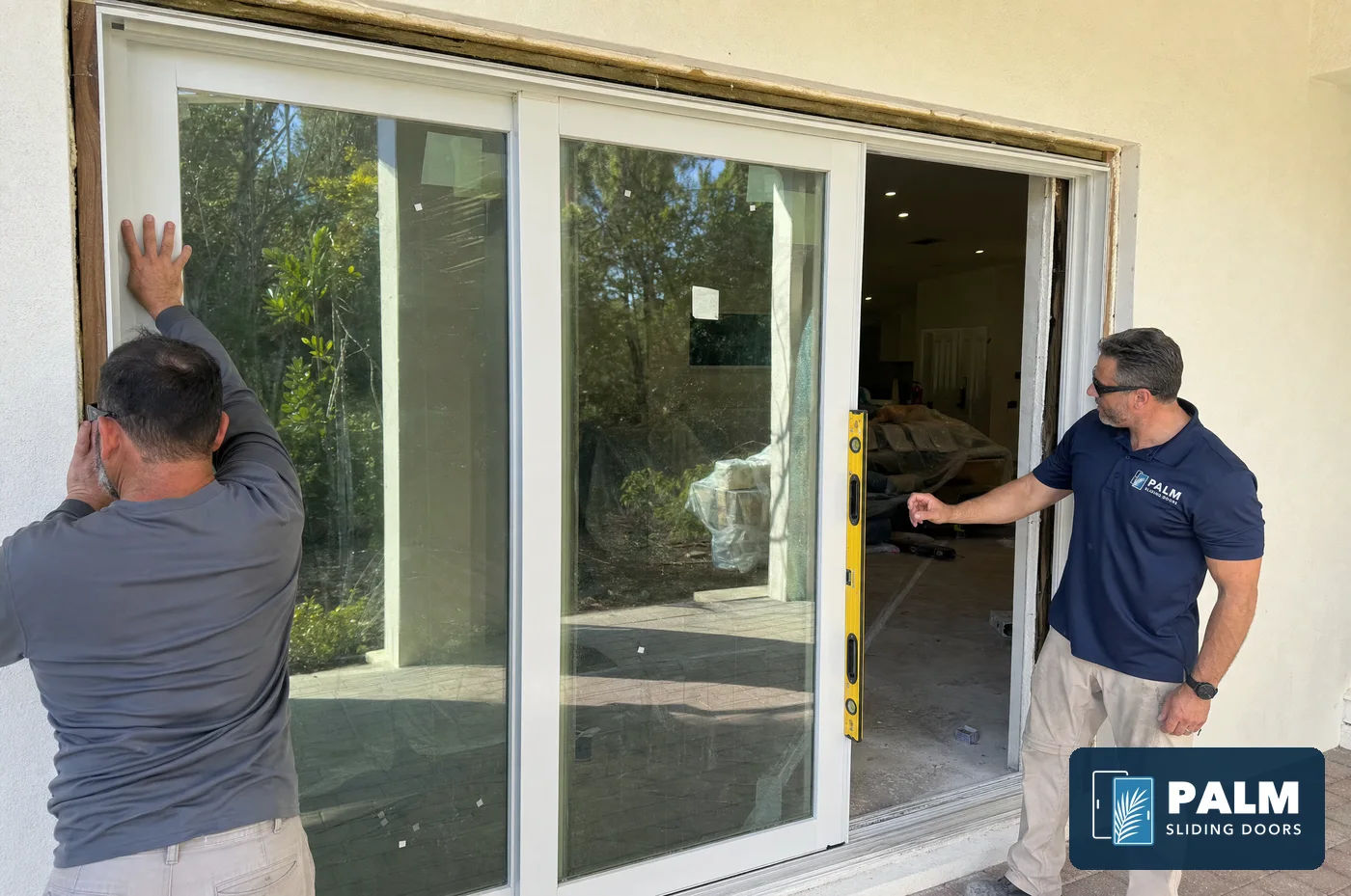
The standard size of a sliding glass door in most Tampa Bay homes is six feet wide by six feet eight inches tall for a two panel door, with eight foot wide and eight foot tall versions close behind. Three and four panel doors run nine, twelve and sixteen feet wide, and all of these are nominal sizes: the actual frame is slightly smaller so it fits a rough opening of the nominal dimension.
This guide lists the common sizes, explains how the nominal size relates to the frame and the rough opening, and walks through how to measure a sliding glass door for a replacement, a new installation, or just to know what you have before you call anyone.
Standard sliding glass door sizes
Sliding glass doors are made in a fairly short list of standard widths and two standard heights, and a huge share of the doors in Tampa, Brandon, Clearwater and St. Petersburg are one of these.
Widths, nominal:
- 60 inches (5 feet). Two panels. Common on older homes and on secondary openings such as a bedroom to a small patio.
- 72 inches (6 feet). Two panels. The most common sliding door width in Florida homes.
- 96 inches (8 feet). Two panels with wider glass, or three narrower panels.
- 108 inches (9 feet). Three panels.
- 120 inches (10 feet). Three panels, or four in some series.
- 144 inches (12 feet). Three or four panels. Common on lanai openings in newer construction.
- 192 inches (16 feet). Four panels, usually two sliding to the center or all sliding to one side.
Heights, nominal:
- 80 inches (6 feet 8 inches). The traditional door height, matched to a standard interior door.
- 96 inches (8 feet). Common in homes built from the 2000s onward and in most new construction.
Panel arrangements are described by letters: an XO door has one sliding panel (X) and one fixed (O), viewed from outside; OXO has a sliding center panel between two fixed; OXXO has two sliders meeting at the center; XXX has three panels that stack. Which panel slides, and toward which side, is part of the size when you order.
Custom sizes exist, and many manufacturers will build to the inch, but a door that matches a standard size is quicker to get and simpler to install.
Nominal size, frame size and rough opening
Three different measurements get called “the size,” and confusing them is how doors arrive that do not fit.
Nominal size is the name of the door: 72 by 80, 96 by 96.
Frame size is the actual outside dimension of the door frame, and it is a little smaller than the nominal size. A nominal 72 by 80 door typically has a frame about half an inch narrower and shorter, though the exact amount varies by manufacturer and series.
Rough opening is the hole in the wall between the framing studs and from the subfloor or slab to the underside of the header. It is the nominal size or slightly larger, leaving room to set the frame plumb and level with shims and to seal around it.
When you replace a door, the new frame has to fit the existing rough opening, or the opening has to be changed. When you install a door in a new opening, the rough opening is built to the manufacturer’s spec for that door. Either way, the manufacturer’s installation sheet for the specific series is the final word, and it is what the installer measures against.
How to measure a sliding glass door
If you want to know what you have, or give an accurate size when you call for a quote, measure the existing door like this. You need a tape measure and a few minutes.
1. Measure the width of the frame. From outside, measure from the outer edge of the frame on one side to the outer edge on the other, at the top, middle and bottom. Write down all three. If they differ by more than a small amount, the frame or the opening is out of square, which is useful to know.
2. Measure the height of the frame. From the top outer edge of the head to the bottom outer edge of the sill, at the left, center and right. Measure to the bottom of the sill, not the top of the track.
3. Note the panel count and which one slides. Stand outside, and from left to right write X for a sliding panel and O for a fixed one.
4. Measure the panel. If you only need a single sliding panel replaced, measure that panel’s width and height frame to frame, and note the glass thickness if you can see the edge.
5. Look at the wall depth. Measure the thickness of the wall from interior finish to exterior finish at the opening. Block walls in Florida are thicker than frame walls, and it affects the frame and trim.
6. Photograph the label. Many doors have a manufacturer’s label on the edge of the sliding panel or in the track. It gives the series and often the size, which makes matching rollers, locks and replacement panels far easier.
Round to the nearest eighth of an inch and give the smallest of the three measurements in each direction. A door is made to the smallest dimension so it fits, and shimmed to fill the rest.
Measuring for a replacement door
For a full sliding glass door replacement, the installer measures the rough opening, which means looking behind the trim to find the framing. That is not something to do yourself on a finished wall, and the reason a proper quote follows a site visit rather than a phone call. Two things the installer checks that a tape measure alone will not tell you:
- Whether the sill sits on a slab or a raised floor, and whether the slab is level. Many Florida sliders sit directly on the lanai slab, and how the new sill is bedded there is what keeps water out.
- Whether the header is sound. The header above a wide opening carries the wall. Rot or termite damage there is found when the old door comes out, and it changes the job.
The quote depends on the opening size, the number of panels, the glass and frame package, and whether the opening or the sill needs work.
Impact doors and design pressure
For an impact sliding glass door, size is tied to something else: design pressure. Each opening has a required design pressure under the Florida Building Code that depends on its size, where it sits on the wall, and the site exposure. Larger panels have to resist more total load, so a wide, tall door needs a product approved for a higher pressure than a small one, or a series with reinforced interlocks and heavier glass. This is why the same nominal size can be quoted in more than one version. Measure the opening, then let the product approval decide what goes in it.
FAQ
What is the most common sliding glass door size?
A nominal 72 by 80 inch two panel door is the most common in Tampa Bay homes, with 96 inch wide and 96 inch tall versions common in newer construction.
Do I measure the sliding door from inside or outside?
Measure the frame from outside, edge to edge, and note the panel arrangement from outside as well, since manufacturers describe doors as viewed from the exterior.
What is the rough opening for a 72 by 80 sliding glass door?
Generally the nominal size or slightly larger, so the frame can be set plumb and shimmed. The manufacturer’s installation sheet for the specific door gives the exact rough opening.
Can I get a sliding glass door in a custom size?
Yes. Most manufacturers build to the inch, and on a replacement it is often simpler to order to the existing opening than to change the wall. Custom sizes take a little longer to arrive.
Are eight foot tall sliding doors standard?
They are now. Eight foot doors became common in Florida construction from the 2000s onward and are a standard height with most manufacturers.
If you have measured your door and want a number, book a free estimate for a sliding glass door installation and we will confirm the measurements, check the opening and quote by the door. If you are trying to work out whether the door needs replacing at all, our guide to replacing a sliding glass door with French doors covers the other direction that decision can go.
References