
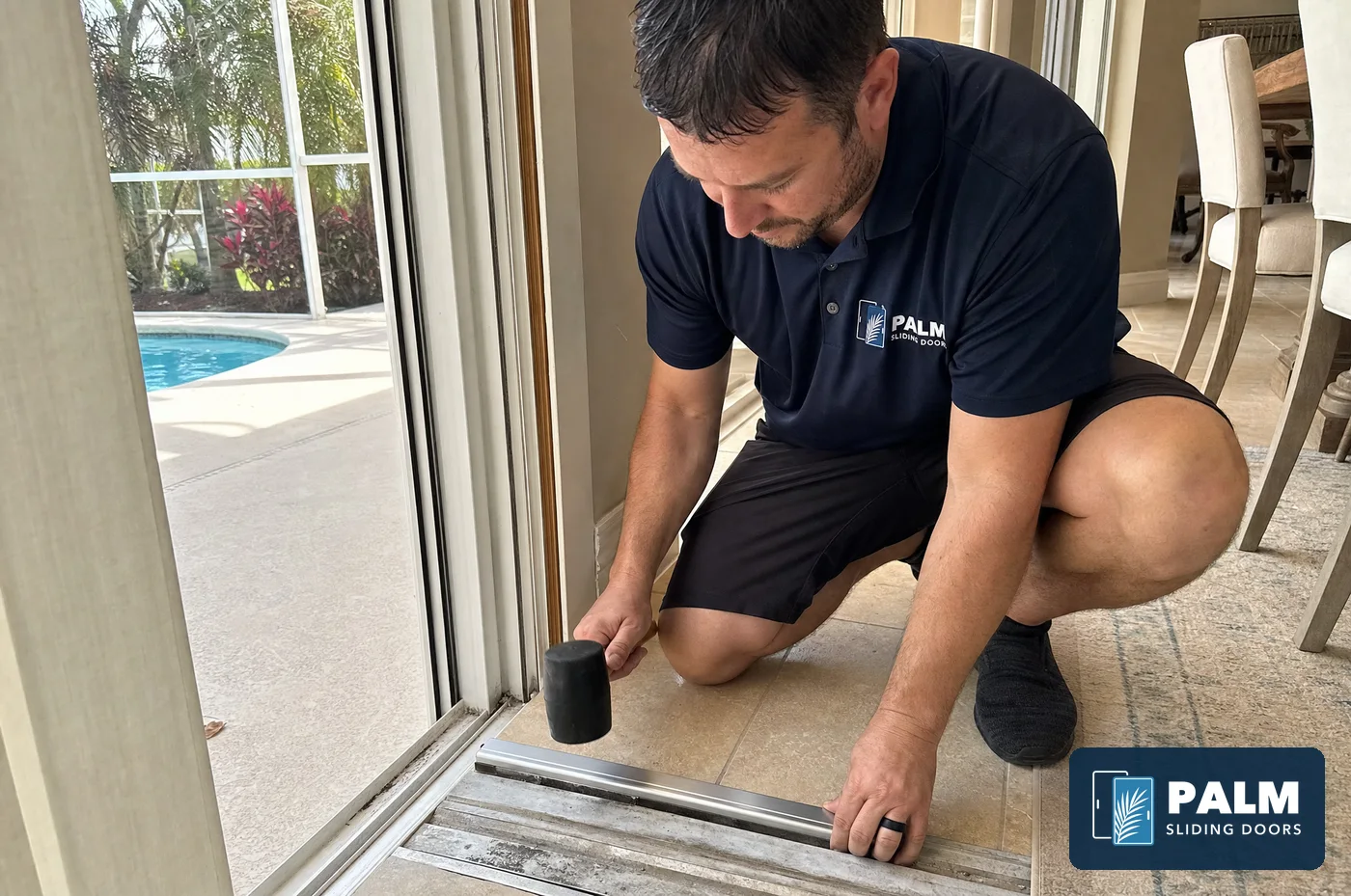
Sliding glass door track repair in Tampa almost always means one of three things: cleaning and straightening a rail that is dented or packed with debris, fitting a stainless steel track cap over a rail that has been worn into a groove, or cutting out and replacing a section of track that has corroded or bent past saving. Most tracks can be repaired rather than replaced, and the repair is done on the same visit as the rollers, because worn rollers and a worn track almost always fail together.
This guide explains how tracks are built, how they fail in Tampa Bay, what a cap actually does, and how to tell when a track is repairable and when the frame has gone too far.
What is the track on a sliding glass door?
The bottom track is the aluminum sill that runs the width of the opening. Down its center, or offset toward the inside, is a raised rail, and the rollers in the bottom of the moving panel ride along that rail. The rail is the working surface: a narrow strip of aluminum carrying the full weight of a glass panel on two small wheels.
Above the door is the head channel, which holds the top of the panel. When people talk about track repair they nearly always mean the bottom rail, because that is where the wear and the corrosion happen. Aluminum is soft. A stainless steel or hardened wheel rolling along the same line for twenty years cuts a groove into it. Once the groove is there, the wheel sits down in it, the panel drops, the interlock and the lock go out of alignment, and the door drags.
How do sliding door tracks fail in Tampa Bay?
Four failures cover almost every track call across Hillsborough, Pinellas and Pasco.
A worn groove. The most common. The rail has a shiny line worn into its top, sometimes deep enough to feel with a fingernail, because when the rollers failed the panel sat directly on the aluminum and cut into it. You see this on nearly every original door in Carrollwood, Brandon and Temple Terrace.
A dent or bend. Something hard was dragged across the track, pool furniture was dropped on it, or a panel jumped the rail and was forced back. The door glides until it hits the dent, then catches or hops. The damage is usually a short section.
Corrosion. Salt air pits aluminum and the pitting roughens the rail. Chlorinated splash from a pool deck and the trapped water in a track with blocked weep holes make it worse. Near the water in South Tampa, Apollo Beach, St. Petersburg and Clearwater, a track can be white with oxidation and rough enough to chew through new nylon wheels in a season. Galvanic corrosion is a second problem: steel screws or steel roller housings sitting in wet aluminum eat away the aluminum around them.
Debris. Sand, dog hair, leaves and dried pool water build up in the channel. The wheels ride up over it and drop off the far side, hammering the rail with every pass. A door that is only dirty does not need a track repair, but one that has been dirty for years usually does.
What does a track cap or track cover do?
A track cap is a length of stainless steel formed to snap over the existing aluminum rail. It gives the rollers a new, hard, smooth surface without removing the old track. Caps come in profiles to match the common rail shapes used across Florida door brands, and they are cut to length on site.
A cap solves the worn groove outright: the groove is under the cap, the wheels ride on stainless steel, and stainless does not groove the way aluminum does. It also bridges light pitting from corrosion.
A cap does not fix a bent rail. If the rail is dented, the cap follows the dent. The rail has to be straightened first, or the dented section cut out, and then the cap goes over a true rail. A cap also cannot rescue a rail that has corroded through or one that has cracked away from the sill, because there is nothing solid left for it to sit on.
Fitting a cap is a normal part of a roller replacement in Tampa Bay, because new rollers on a grooved rail drop into the groove and the door is heavy again within a year. Our guide to roller replacement covers the roller side of the same visit.
When can a track be repaired and when does it need replacing?
Here is how a technician decides, in order.
- Clean it and look. Vacuum the channel, wipe the rail, clear the weep holes. A surprising number of “track problems” are just debris, and the rail underneath is sound.
- Check the rollers. If the panel has dropped, the rollers are the primary failure and the track wear is a consequence. Both get fixed together.
- Find the damage. Run a fingertip and a straightedge along the rail. A groove means a cap. A dent means straightening or a section repair. Pitting means a cap if it is light, or a section if it is deep.
- Test the sill. The rail is part of the sill extrusion. If the sill is soft, cracked or lifting from the slab, the track cannot be saved in isolation.
Repairable, same visit: worn grooves, light to moderate pitting, short dents, a rail that has been burred by a jumped panel, debris and drainage problems.
Section replacement: a rail bent over a longer run, cracked, or corroded so deeply a cap would sit on nothing. The damaged section is cut out, matching rail is fixed in place, and the whole run is capped so the joint is smooth. Still a repair, not a new door.
Replacement of the door: the sill is corroded through or the frame legs are pitted so badly the panel cannot seal. That is where sliding glass door replacement is the honest recommendation, and it usually shows up on waterfront doors that have gone decades without stainless parts.
Why are saltwater and pool cages so hard on tracks?
Tampa Bay combines the two things aluminum tracks like least.
Salt air lands on every outdoor surface within a few miles of the bay and the Gulf, and a sliding door track is a horizontal channel that holds whatever lands in it. Salt plus humidity plus aluminum equals oxidation, and a steel roller housing or screw makes the aluminum around it corrode faster still. Doors on Davis Islands, along Bayshore, in Gulfport and on Clearwater Beach show this within a decade.
Pool cages create their own weather. The screen keeps the wind off, so the track dries slowly. Pool water lands on the track with every splash, sand tracks in from the deck, and a caged lanai door is the most used door in the house, so every bit of grit gets ground into the rail.
The answer on both is the same: stainless steel rollers, a stainless track cap, clear weep holes and a track that gets vacuumed a few times a year. Stainless does not corrode in salt and does not groove under load, which is why it is the default on every Palm Sliding Doors repair rather than an upgrade.
What does a track repair visit look like?
The technician removes the sliding panel so the track is fully exposed, cleans it, measures the damage, and does any straightening or section work. The cap is cut to length and fitted, the rollers are replaced if worn, and the panel goes back in and is adjusted until it sits plumb, the interlock closes and the lock catches without lifting. A standard track repair is one visit with parts from the truck. The written quote comes after the inspection and before the panel comes out, and it depends on the length of the track, whether a section needs replacing rather than capping, the roller type, and whether the panel is a standard or heavy unit.
Palm Sliding Doors is locally owned and insured, based in South Tampa and serving Hillsborough, Pinellas and Pasco with same-day track and roller work, a free on-site inspection and a 1-year parts and labor warranty. If your door catches, hops or drags in one spot, contact us and we will tell you whether the track can be saved.
Frequently asked questions
Can a bent sliding glass door track be repaired?
Usually. A short dent is straightened or the section is cut out and replaced with matching rail, and the whole run is capped in stainless steel. A rail bent over its full length, or a sill that has cracked, is a replacement conversation.
What is a sliding door track cap?
A stainless steel strip formed to snap over the existing aluminum rail. It gives the rollers a hard, smooth surface over a worn groove or light corrosion and lasts far longer than the original aluminum.
Do I need new rollers if I get a track cap?
Almost always. A grooved rail is a sign the rollers have already failed, and old rollers on a new cap wear it unevenly. The two are done together on one visit.
How do I stop my track from corroding again?
Use stainless steel rollers and cap, keep the weep holes clear so water drains, and vacuum the track a few times a year. Never use oil or grease in the track; a dry silicone spray on a clean rail is the only lubricant that belongs there.
Is track repair a same-day job?
Yes on a standard door. Cleaning, straightening, capping and rollers are all done with parts from the truck. A long section replacement on a rare track profile can need a return visit once the rail is matched.
For the service itself, see sliding door track repair. Pinellas homeowners near the water can read about roller replacement in St. Petersburg and the neighborhoods we cover from the St. Petersburg area hub.
References