
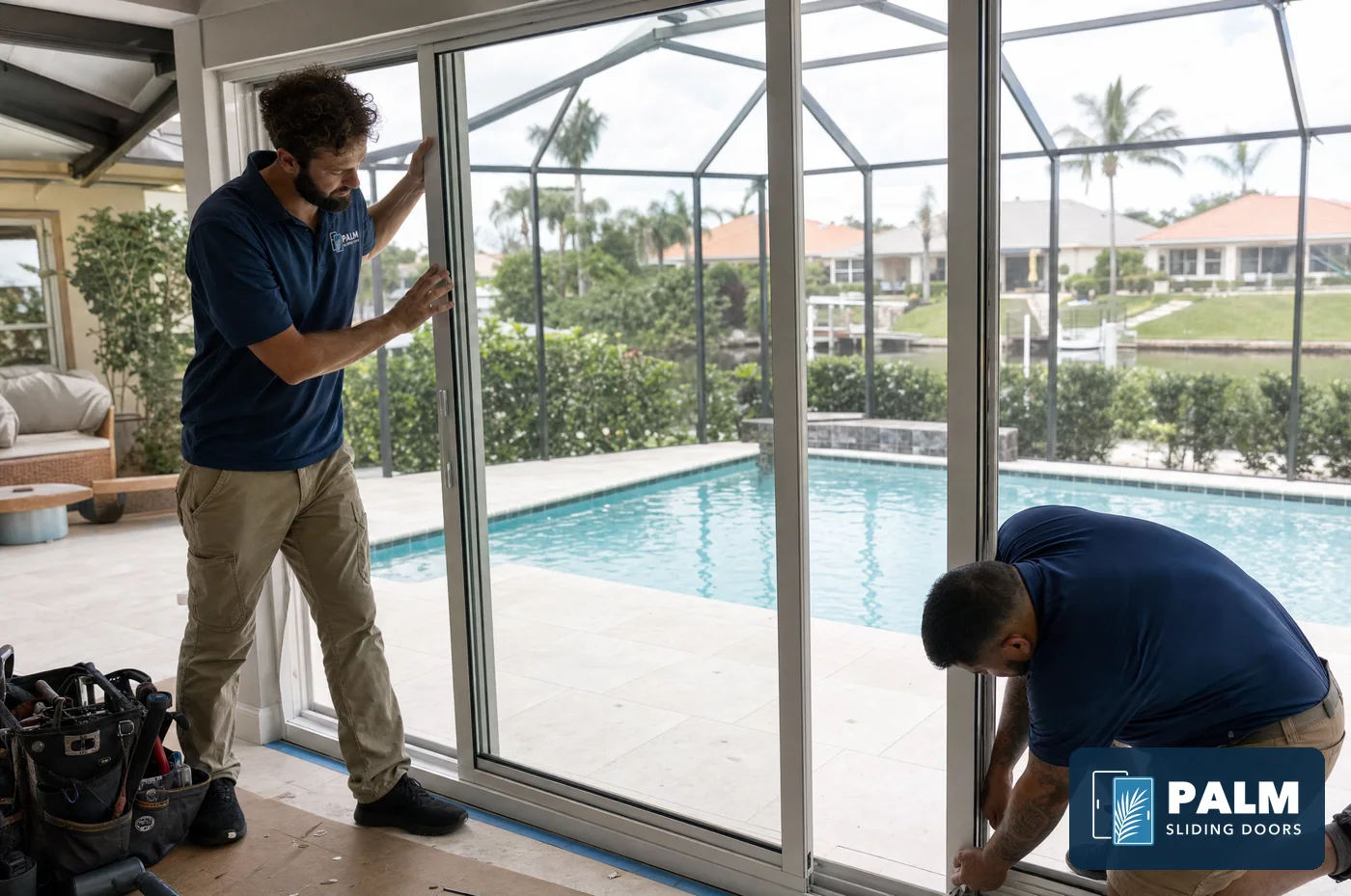
A hurricane impact sliding glass door is a door whose glass, frame and hardware have been tested together as one assembly to survive a large flying object and then hold up under hours of storm wind pressure, and it carries a Florida product approval that says so. In Tampa Bay, an impact door is what lets a lanai or pool opening meet the Florida Building Code without shutters or panels, and a permit is required to install one.
This guide explains the jargon, design pressure, HVHZ, laminated versus tempered, in plain words, along with what actually applies to a home in Hillsborough, Pinellas or Pasco, what to expect from insurance, and how the permit works.
What makes a sliding glass door impact rated?
An impact door is not just a door with thicker glass. It is a system, and the rating belongs to the whole system.
Laminated glass. Two sheets of glass bonded to a tough plastic interlayer. When something hits it hard enough to break the glass, the pieces stay stuck to the interlayer and the panel stays in the frame. Wind cannot get in, so the pressure inside the house does not spike and lift the roof. That is the whole purpose. Ordinary tempered door glass is strong but when it breaks it drops out entirely.
A reinforced frame. Heavier aluminum extrusions, often with internal reinforcement at the interlock and the meeting rails, so the frame does not bow under sustained pressure.
Heavy-duty hardware. Multi-point locks, stronger keepers, tandem stainless rollers rated for the extra weight, and anti-lift blocks so the panel cannot be pushed out of the track.
Testing as an assembly. The complete door is mounted in a test wall, hit with a nine-pound piece of lumber fired from a cannon, then cycled through thousands of pressure loads that simulate gusts. If the glass stays in the frame, it earns a rating.
A product approval. The results are filed as a Florida Product Approval, or a Miami-Dade Notice of Acceptance for products sold into South Florida. The approval number is what the building inspector checks. A door without one is not an impact door no matter what the salesperson says.
What is design pressure and why does it matter in Tampa?
Design pressure, written as DP, is the amount of wind load the door has been tested to hold. It is given as a positive number for wind pushing in and a negative number for wind pulling out, and the negative side is usually the one that governs because suction on the lee side of a house is stronger than most people expect.
The pressure a door must meet depends on the wind speed for your location, how high the door sits, whether the home is near open water, and where the door is on the house. A corner opening on a waterfront home in Apollo Beach or on Davis Islands needs a higher rating than a sheltered courtyard door in Wesley Chapel. The installer works this out from the code maps and specifies a door whose approved pressure meets or exceeds the required number, and that rating is worth checking on any quote you compare.
How does the Florida Building Code apply to Tampa Bay?
Florida has two levels of hurricane rules, and the confusion between them is common.
The High Velocity Hurricane Zone, or HVHZ, is Miami-Dade and Broward counties only. It has the strictest testing and requires the Miami-Dade approval. Tampa Bay is not in the HVHZ.
The wind-borne debris region is the wide coastal band where the code requires every opening, including sliding doors, to be protected from flying debris. Most of Hillsborough, Pinellas and coastal Pasco fall inside it. Protection can be impact-rated glass or code-approved shutters and panels. This is the rule that applies to most Tampa Bay homes.
In practice, when you replace a sliding door in South Tampa, St. Petersburg, Clearwater or Brandon, the new door either needs to be impact rated or needs an approved shutter system over it. Inland addresses further from the coast may sit outside the debris region, and the installer confirms this from the maps for your exact address.
A door tested to the HVHZ standard is accepted everywhere in Florida, including Tampa, so a Miami-Dade approved door is never a wrong choice here. It is simply tested beyond what the local zone requires.
Laminated glass versus tempered glass: what is the difference?
Tempered glass is heat-treated so it is several times stronger than ordinary glass and shatters into small, blunt cubes. Every sliding door in Florida has tempered glass at minimum because it is a safety requirement. Tempered glass is not impact rated: it is strong, but when it does break, it is gone, and the opening is open.
Laminated glass is what makes a door impact rated. Two lites of glass, often tempered themselves, with a clear interlayer bonded between them. On an impact hit the outer glass cracks, the interlayer holds everything together and the panel stays sealed. Laminated glass also blocks most ultraviolet light and noticeably reduces outdoor noise. Some impact doors use a laminated insulated unit, which adds an air space for energy efficiency.
The weight is the practical difference. A laminated impact panel is much heavier than a tempered one, which is why impact doors need tandem stainless rollers and why installing one is a two-person job.
Do impact doors earn an insurance discount?
Yes, Florida insurers offer wind mitigation credits for homes with protected openings, and impact doors and windows qualify when every opening is covered. The credit is applied after a wind mitigation inspection, which documents the openings, the roof and the construction.
Two cautions. The credit typically requires all openings to be protected, so one impact door on a house with unprotected windows may not qualify on its own. And the amount varies by carrier and by policy, so ask your agent what applies to you rather than relying on a figure from any door company. The credit is real, it recurs every year, and it is one of the reasons impact doors make sense beyond the storm itself.
Are permits required and who pulls them?
Yes. Replacing a sliding glass door with an impact door is permitted work in every Tampa Bay jurisdiction. The permit is pulled by the installer of record, not the homeowner, and the installer’s contractor credentials are what the permit is issued against.
The process runs like this. The installer submits the product approval for the specific door, the design pressure calculation for your opening, and the installation details to the county or city building department. Once the permit is issued the door is installed according to the approved method, which specifies the anchor type, spacing and depth into the concrete or block. The inspector visits, checks the anchors and the approval label on the door, and closes the permit.
A closed permit is what proves to your insurer, your future buyer and your HOA that the door is what it claims to be. An offer to install without a permit means no inspection, no record, possibly no insurance credit, and a problem at resale.
What does installation involve on a Tampa Bay home?
Most Tampa homes are concrete block, and impact doors anchor directly into it. On an older block home in Seminole Heights or Temple Terrace the original door was often set with a few screws into a wood buck; an impact door needs anchors at close spacing into the block itself, with the sill pan and flashing done properly so wind-driven rain has nowhere to go. The old door comes out, the opening is checked for square and rot, the new frame is set and anchored, the panels are hung, the rollers and multi-point lock are adjusted, and the exterior is sealed. On a condo balcony the association’s specifications on frame color and glass tint apply.
Our page on hurricane impact sliding glass doors covers the door options. Existing impact doors also need looking after, because a door that will not lock fully is not protecting anything; our hurricane season checklist walks through what to check each spring.
Palm Sliding Doors is a locally owned, insured company in South Tampa installing impact sliding doors across Hillsborough, Pinellas and Pasco, with a free on-site inspection and permits handled by the installer of record. If you would like the design pressure for your opening worked out and a written quote, contact us.
Frequently asked questions
Does Tampa require impact sliding glass doors?
Tampa Bay is not in the High Velocity Hurricane Zone, but most of it is in the wind-borne debris region, where every opening must be protected by impact glass or approved shutters. A replacement door in the debris region must be impact rated or covered by shutters.
What is the difference between impact glass and tempered glass?
Tempered glass is strong but shatters completely when it breaks. Impact glass is laminated: two lites bonded to an interlayer, so the glass cracks but stays in the frame and the opening stays sealed.
Do I need a permit to replace a sliding door with an impact door?
Yes. The installer of record pulls the permit, submits the product approval and pressure calculation, and the door is inspected before the permit is closed. Avoid any installer who suggests skipping it.
Will an impact door lower my insurance?
Many Florida carriers give wind mitigation credits for protected openings. The credit usually needs every opening protected and is confirmed by a wind mitigation inspection. Ask your agent what your policy offers.
Can an existing sliding door be upgraded to impact glass?
Usually not. The rating belongs to the whole tested assembly, so laminated glass in a non-impact frame does not make an impact door. Replacing the full unit is the only way to get an approved rating.
South Tampa homeowners on the waterfront can read more on our impact sliding doors in South Tampa page, and the South Tampa area hub lists the neighborhoods we serve.
References