
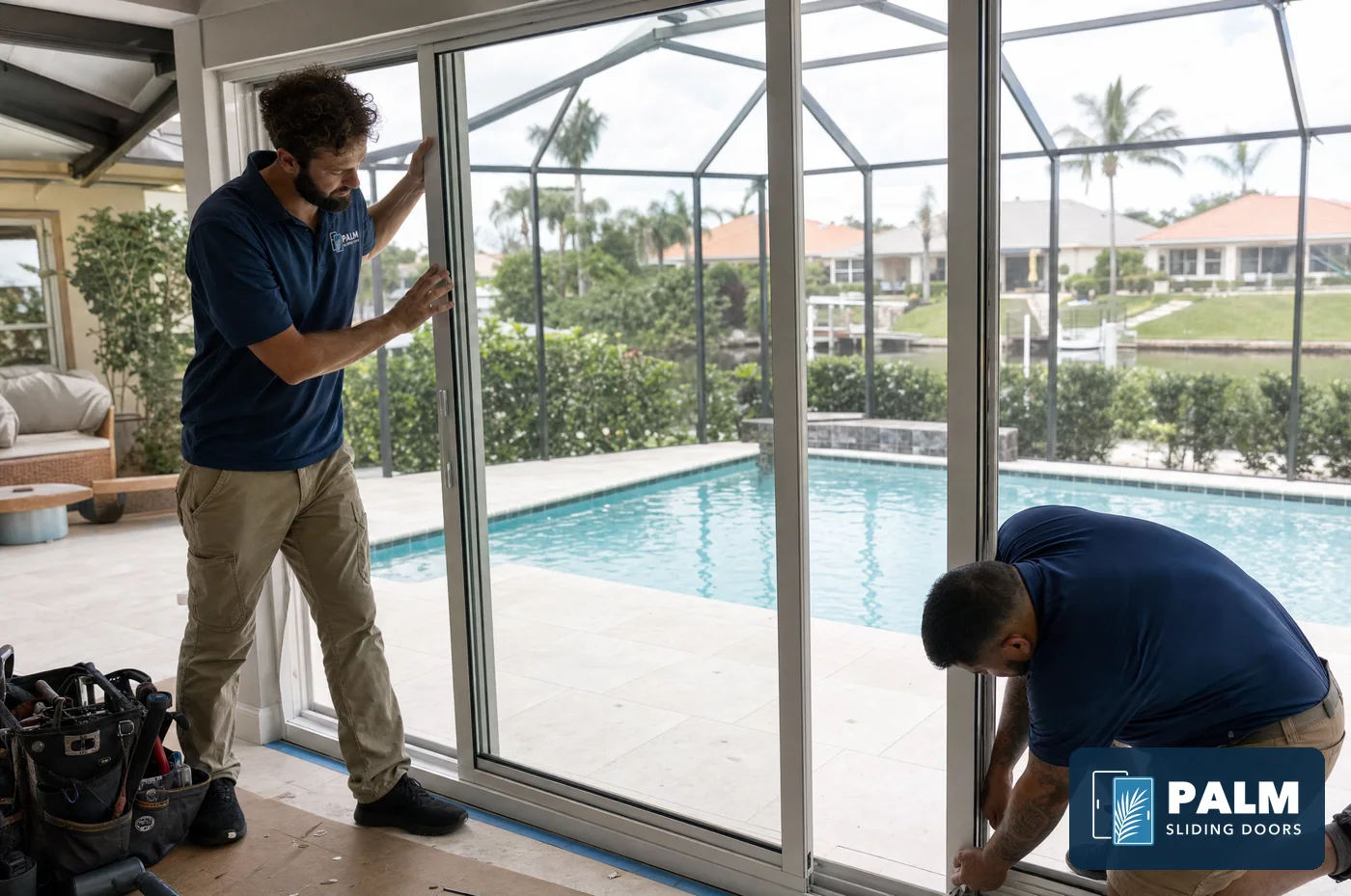
The sliding glass doors on a Tampa Bay home are its largest and most exposed openings, and the right time to check them is before June, not the day a storm is in the Gulf. Hurricane impact sliding glass doors need an annual inspection of their glass, seals, locks and anchors; standard sliders need their track, weep holes and shutters checked; and every lanai needs the loose items dealt with before the wind arrives.
This checklist is organized in that order: what to inspect on an impact door, what to fix on any sliding door before the season, and what to do in the last day or two before a named storm. It applies whether you are in Tampa, St. Petersburg, Clearwater or Brandon.
Part 1: Impact door inspection
An impact sliding glass door protects the house only if it is still the product that was tested. Once a year, ideally in the spring, walk through this.
Glass. Look at every lite for cracks, chips at the edges and any sign of delamination, which shows as a cloudy or bubbled area at the edge of the glass where the interlayer has separated. A cracked laminated lite still holds together, but it is no longer rated and should be replaced through a glass replacement before the season.
Label. Find the manufacturer’s label on the panel edge or frame. It should be there and legible. It is how a wind mitigation inspector or an adjuster confirms the door is rated, and a missing label makes that conversation harder.
Locks. An impact door usually has a multipoint lock that engages the frame at more than one height. Close the door and lock it without lifting or slamming. Every point should engage. A lock that needs a lift means the panel has dropped on its rollers, and a door that is not fully locked is not fully rated.
Rollers and panel height. The panel should sit level with an even gap along the bottom. Impact panels are heavy and their rollers work hard; a panel that has dropped puts stress on the interlock and the lock and lets water in at the sill. A roller replacement on an impact door is a heavy duty job, and it is better done in April than in September.
Interlock and weatherstrip. Where the sliding and fixed panels meet, the interlock should engage along its full height. The weatherstrip in the jambs and the sweep along the bottom should be intact and touching. Wind driven rain finds any gap.
Frame anchors and sealant. Look along the inside and outside of the frame for loose screws, cracked or missing sealant, and any sign the frame has moved. The anchors are part of the product approval, and a rated door that is not anchored to schedule is not a rated opening. If you see gaps, have it looked at.
Sill and weep holes. The small slots in the bottom of the sill let water that gets into the track drain outside. Clear them with a thin wire or a blast of water from the outside. Blocked weeps are the most common reason an impact door “leaks” in a storm when nothing is actually wrong with the door.
Part 2: Fixes to make before the season on any sliding door
If your door is a standard slider protected by shutters, or you are not sure what it is, this is the list.
Clean and lubricate the track. Vacuum it, wipe the rail, and use dry silicone spray only. A door you can close and lock quickly matters when the wind picks up.
Fix a door that drags or will not lock. A heavy door is a roller problem, and a lock that misses the keeper is a dropped panel. Both are a sliding glass door repair that takes one visit and means the door will actually close when it has to.
Check the shutters or panels. If the door is protected by removable panels, find them, count them, check the tracks or bolts on the wall, and do a trial fit on a calm weekend. Missing wing nuts and a panel that does not match its opening are found in April with no consequences and in September with plenty. Accordion and roll down shutters should be run through a full cycle and their tracks cleaned.
Replace failed or fogged glass. Fogged glass is a failed seal, and a cracked lite is a weak lite. Neither belongs on an exterior door going into storm season.
Decide about impact glass. If the door is old, leaks, or you are tired of hanging panels, this is the moment to price a hurricane impact sliding glass door. Impact doors are built to order and lead times stretch once the first storm forms. Many carriers offer wind mitigation credits for rated opening protection; confirm the details with your carrier.
Part 3: The lanai and the openings around it
The sliding door does not face the storm alone. The lanai in front of it is full of things that become debris.
- A screened cage is not storm protection for anything, including the door behind it. It is designed to fail in high wind, and its panels and frames can take out glass on the way.
- Furniture, planters, grills and pool equipment go inside the garage or house, or are strapped down if they truly cannot be moved. A patio chair through a standard slider is the classic Tampa Bay claim.
- Gates and doors to the lanai should be latched so they do not swing and slam.
If the lanai has a second opening, such as a window or a set of French doors into a bedroom, it goes through the same inspection as the main slider. A French door under an impact rating needs its flush bolts engaged and its astragal sound; if a leaf sags or a bolt does not seat, that is a French door repair to book now.
Part 4: The day or two before a named storm
By this point the work is checking, not fixing.
- Close and lock every sliding door, engaging all points on a multipoint lock. Set any foot bolt or secondary lock.
- Deploy shutters or panels over any opening that is not impact glass. Do it while it is still calm; second story panels in a gust are dangerous.
- Clear the lanai as above and store the screen door if the lanai is open.
- Check the weep holes one more time.
- Move anything valuable away from the inside of the glass. Even an impact door can crack, and a cracked lite can leak.
- Photograph every door and opening from inside and out, with the date. If there is a claim, you will want the before pictures.
After the storm
Once it is safe, look at every door again. Cracked laminated glass has done its job and needs replacing. A panel that no longer slides may have debris in the track or a bent rail. Water at the sill is usually blocked weeps or a shifted seal. Anything that changed in the storm is worth a visit; a door that leaks after one storm will leak more in the next, and an emergency call for a broken panel gets the house closed up quickly.
FAQ
How often should impact sliding glass doors be inspected?
Once a year, before the season starts. Check the glass, label, locks, rollers, seals, anchors and weep holes, and fix anything that has moved or worn.
Do impact sliding doors need shutters too?
No. A rated impact door is opening protection on its own. Shutters are for openings that are not impact rated.
What is the most common reason a sliding door leaks in a storm?
Blocked weep holes in the sill, followed by a dropped panel whose interlock and weatherstrip no longer seal. Both are quick to fix before the season.
Should I take the screen door off before a hurricane?
If the lanai is open to the weather, yes. Store it flat. A screen door on an enclosed, caged lanai should be latched, and the cage itself should not be counted on for anything.
Is it too late to get an impact door once a storm is forecast?
Yes, for that storm. Impact doors are built to order and lead times grow through the summer. Order in the off season and have it installed before June.
If any item on this list turned up a problem, book a visit for hurricane impact sliding glass doors and we will inspect the door, fix what can be fixed on the spot, and quote anything larger by the opening. For a standard slider that is heavy or will not lock, our guide on how to fix a sliding glass door that won’t slide covers what we check first.
References