
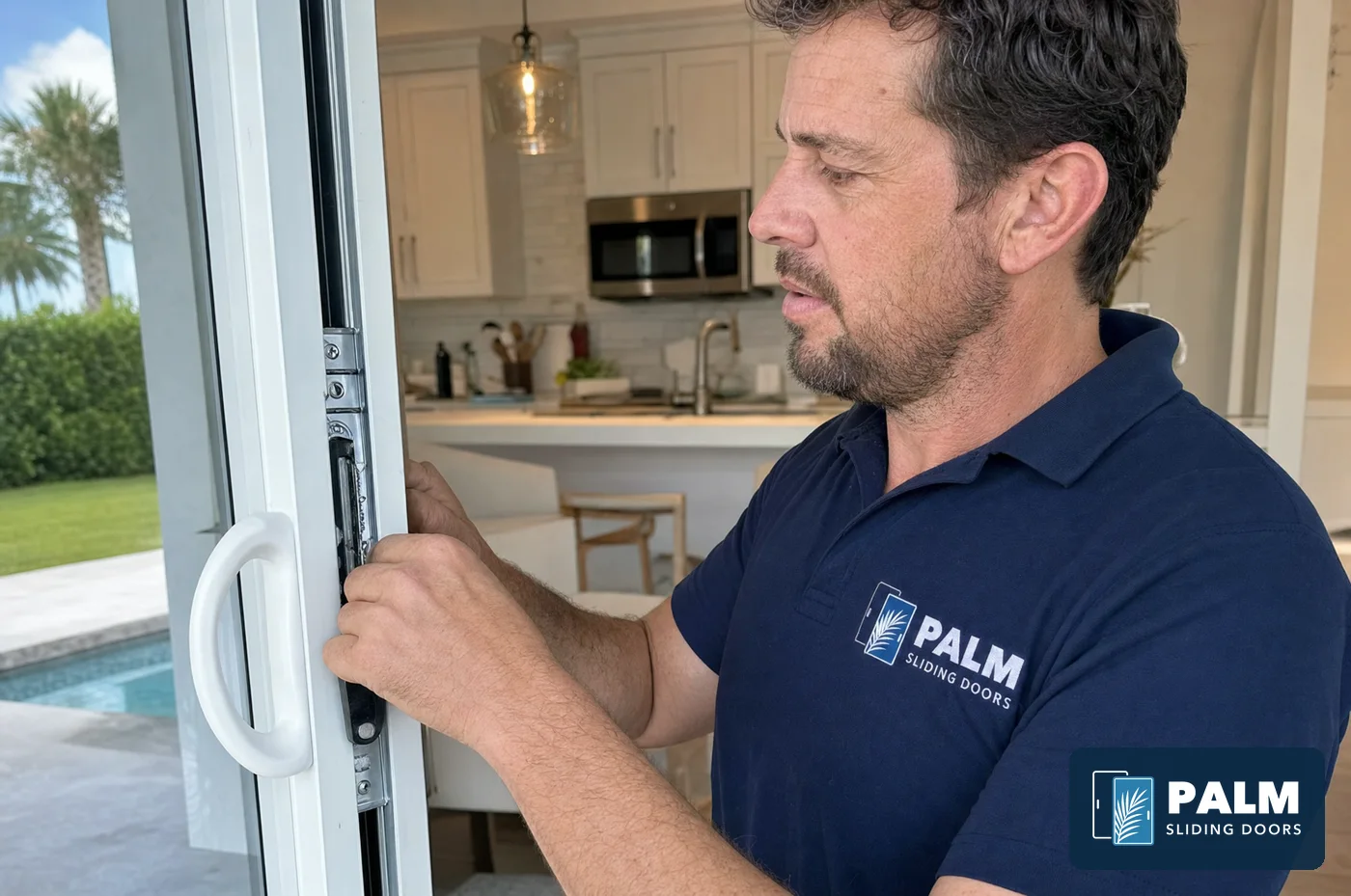
To secure a sliding glass door you have to close off three separate ways in: forcing the lock, lifting the panel out of its track, and breaking the glass. A working mortise lock plus a secondary lock handles the first, anti lift pins and correctly adjusted rollers handle the second, and laminated impact glass handles the third.
This guide is organized around how a sliding door is actually defeated, so you can see which weakness your own door has and fix that one first. We covered a cost ranked version of the same list in how to secure a sliding glass door; this post goes deeper on the lock, the lift, and the glass, and on what a sliding glass door lock replacement really involves.
Attack 1: Forcing the lock
The factory lock on nearly every sliding glass door is a mortise lock inside the handle: a small hook that swings out and catches a keeper on the jamb. It was designed to keep the door closed against the wind, not against a pry bar. On a door in Tampa Bay that has seen twenty summers, it often does not even do that, for two reasons.
The lock is worn. The hook, the spring or the cam inside the mortise body wears until the hook no longer swings fully or will not hold. The handle flops, the thumb turn spins, or the door “locks” and then slides open with a nudge.
The keeper is missed. As the rollers wear, the panel drops. The hook now sits below the keeper and only catches if you lift the door as you close it. Many homeowners have lived with this for years without realizing the door was effectively unlocked whenever they forgot the lift.
What a sliding glass door lock replacement involves
A proper lock and handle repair is more than swapping the handle.
- The mortise lock body is identified by its face plate size, hook style and hole spacing, and matched with the correct replacement. There are dozens of patterns across the door brands sold in Florida.
- The old mortise is removed from the panel edge and the new one fitted, with the handle set and thumb turn to match.
- The keeper on the jamb is realigned or replaced so the hook engages fully.
- The rollers are adjusted so the panel sits at the right height and the hook catches without lifting. If the rollers are gone, this is the moment to replace them, because no lock adjustment survives a panel that keeps dropping.
- The lock is tested from both sides, and a keyed exterior handle is added if you want to lock the lanai side.
The quote depends on the mortise pattern the door takes and whether the rollers need attention on the same visit. Done properly, it is a single visit and the foundation for everything else on this list.
Add a second lock that works differently
Even a new mortise lock is a hook. A second lock of a different type multiplies the effort needed from outside.
- Foot bolt. Mounted on the bottom of the sliding panel, it drops a bolt into a hole drilled in the track. Strong, cheap, and you set it with your foot.
- Loop lock. A hinged loop on the sliding panel that pins to the fixed panel. It works even if the mortise lock fails.
- Security bar. A bar in the bottom track behind the sliding panel so it cannot be pushed open. Buy a hinged one that swings up so you actually use it.
Attack 2: Lifting the panel out
This is the weakness most homeowners do not know about. The sliding panel of many doors, especially older aluminum sliders, can be lifted straight up into the head channel, swung out of the bottom track, and set aside, with the lock still locked. It takes seconds if the clearance is there.
The clearance is there for two reasons: the head channel is deep by design so the panel can be installed, and a panel that has dropped on worn rollers has even more room above it.
Closing the lift
- Anti lift pins or blocks. Screws or blocks fitted into the head channel above the sliding panel reduce the clearance so the panel cannot rise far enough to clear the bottom track. They are set so the door still slides freely, and they are removed only when the panel needs to come out for service.
- Rollers at the right height. A roller replacement with a proper adjustment brings the panel back up to where it should sit, which takes away the extra lift room and fixes the dragging door at the same time.
- Check the fixed panel. On some doors the fixed panel is held only by a small bracket and can be pushed out of its channel. A fixed panel clip or screw stops that.
Attack 3: Breaking the glass
Everything above stops someone opening the door. None of it stops a rock, a bat or a shoulder through the glass. The standard glass in a sliding door is tempered, which is a safety requirement under Florida building code, and tempered glass is designed to break into small blunt pieces. That is safe for a child who runs into it and terrible for security: one strike and the whole lite falls out of the frame, leaving a clear opening.
Laminated impact glass
Laminated glass is two lites bonded to a tough interlayer. When struck it cracks but stays in the frame, held by the interlayer and the glazing channel. There is no opening to climb through, and getting through takes noise, time and repeated blows, which is exactly what an intruder does not have.
It is the same glass that protects a house in a hurricane, and it also blocks most UV and cuts noise. There are two ways to get it:
- Glass replacement in the existing panel, if the glazing channel is deep enough for the thicker laminated unit. This is a sliding door glass replacement and it keeps your existing frame and hardware.
- An impact rated sliding door, which brings laminated glass, a reinforced frame anchored to the structure, a multipoint lock and a Florida Product Approval for the whole opening. A rated impact sliding glass door is the most complete answer to all three attacks in one product, and it can help with a wind mitigation credit; many carriers offer credits for rated opening protection, so confirm the details with your carrier.
Putting the three together
Here is the order that gives the most security for the least spend on a typical Tampa or Brandon home:
- Fix the mortise lock and align the keeper so the door truly locks without a lift.
- Adjust or replace the rollers so the panel sits at height.
- Fit anti lift pins in the head channel.
- Add a foot bolt or loop lock.
- When the budget allows, move to laminated glass, either in the panel or as a full impact door.
Steps one through four are one service call. Step five is the upgrade that also takes care of storm season.
FAQ
How do burglars get through sliding glass doors?
Three ways: forcing or bypassing a worn hook lock, lifting the panel out of its track, or breaking the tempered glass. Each has a specific fix, and a door is only secure when all three are covered.
Can a sliding glass door lock be replaced without replacing the door?
Yes. The mortise lock inside the handle is a standard replaceable part. The job is matching the correct pattern, realigning the keeper and adjusting the rollers so the hook engages.
What is the best lock for a sliding glass door?
A working mortise lock plus a second lock of a different kind, such as a foot bolt or loop lock, plus anti lift pins. No single lock does all three jobs.
Does impact glass make a sliding door burglar proof?
Nothing is burglar proof, but laminated impact glass stays in the frame when struck and turns a one second break into a loud, slow job. Combined with a proper lock and anti lift pins, it removes the easy ways in.
Are anti lift pins hard to install?
No. They are small screws or blocks set in the head channel above the sliding panel. The trick is setting them so the door still slides freely but cannot rise enough to clear the track.
If your door fails any of the three tests above, book a lock and handle repair and we will replace the mortise lock, align the keeper, adjust the rollers and fit anti lift pins on the same visit. If you would rather close all three gaps at once, ask about impact glass while we are there.
References