
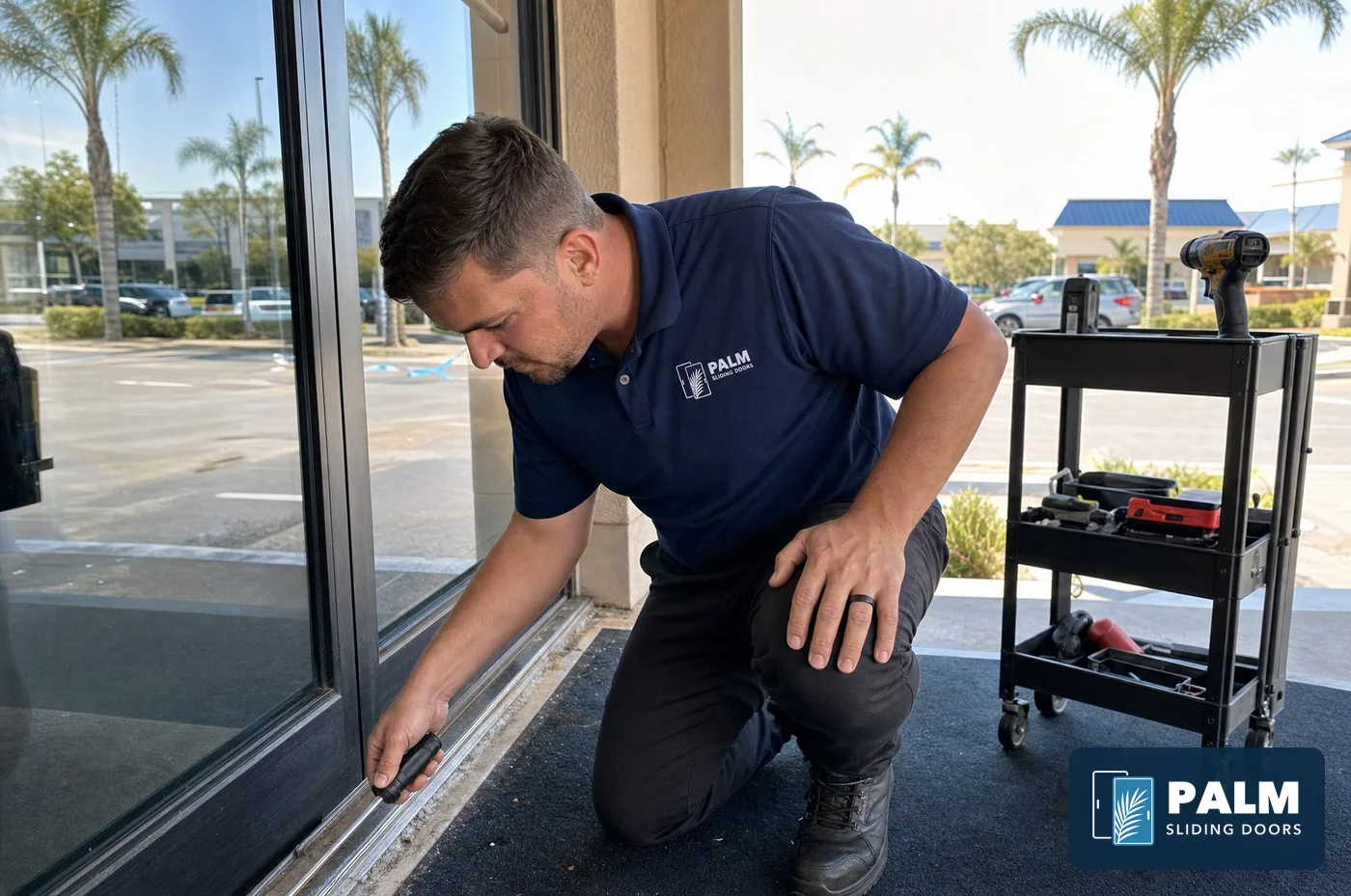
Commercial sliding door repair in Tampa covers the heavy manual sliding doors on storefronts, restaurant patios, condo balconies, hotel rooms and clubhouse lanais, and it differs from residential work in three ways: the doors are heavier and take commercial-grade rollers and hardware, the glass must meet safety glazing rules for the location, and the work has to fit around tenants, guests and business hours. A company that does commercial work regularly schedules after hours, carries heavy-duty parts, and documents every repair for the property manager or association.
If you manage a building or run a business in Tampa Bay, this guide explains what breaks on commercial sliding doors, what the repair involves, how condo and HOA rules affect it, and how to set up a repair relationship that does not involve a fresh explanation every time a door sticks.
What counts as a commercial sliding door?
The line is not always obvious, so here is how we draw it.
Storefronts and offices. Manual sliding glass doors on retail units, office suites and medical buildings, often in aluminum storefront framing rather than residential door frames. Heavy panels, high traffic, and glass that must be safety rated.
Restaurants and bars. Patio and terrace sliders, sometimes multi-panel or stacking, that open a dining room onto a deck. They get opened and closed hundreds of times a day, they live in a salt-and-grease environment, and they cannot be out of service at dinner.
Condos and apartments. Balcony and lanai sliders in multi-unit buildings, which is the largest category in downtown Tampa, along Bayshore, in St. Petersburg and on Clearwater Beach. Individually they look residential. Across a building there are hundreds of them, they are usually the same model, and the association controls the exterior appearance.
HOA amenities. Clubhouses, fitness rooms and pool buildings in the master-planned communities of Wesley Chapel, Riverview, Trinity and Lutz. High use, shared responsibility, and a board that wants one invoice.
Hotels and vacation rentals. Balcony doors that must lock reliably, work for every guest, and be fixed between checkout and check-in.
What breaks on commercial sliding doors?
The same things as residential doors, faster and harder.
Rollers. A storefront or restaurant slider carries a heavy panel through thousands of cycles a month. Residential rollers fail in a season under that load. Commercial doors take heavy-duty tandem stainless steel rollers with sealed bearings, and the wrong roller is the most common reason a “repaired” commercial door fails again within weeks.
Tracks. Grit from a parking lot, salt from the bay, and a door that never stops moving groove an aluminum rail quickly. Stainless track caps and section replacements are routine.
Locks and handles. Commercial doors need locks that stand up to hundreds of uses a day and, in many cases, keyed cylinders that fit a building’s key system. Handles on high-traffic doors loosen and snap. Balcony doors in condos need locks that a guest or tenant cannot easily defeat and that meet the building’s security expectations.
Glass. Commercial glass must be safety glazing, meaning tempered or laminated, wherever the code requires it, which for a sliding door is everywhere. Storefronts near the ground and doors near walking surfaces have particular requirements, and any replacement lite must carry the safety marking. Impact glass is common on newer coastal buildings and is replaced like for like.
Weatherstripping and interlocks. On a building with hundreds of identical sliders, worn pile means air conditioning loss on every floor and water intrusion complaints after every storm. Replacing it building-wide on a schedule is far cheaper in disruption than one unit at a time.
How is commercial repair different from residential repair?
The mechanics are similar. The job around the mechanics is not.
Heavier parts. Commercial roller assemblies, reinforced keepers, heavy-duty handles and thicker glass. A residential-focused company may not carry them.
Documentation. A property manager needs a written report per door: what was found, what was replaced, and what is likely to fail next. For a condo, the association may need the report to support a maintenance reserve or to decide between repair and a building-wide replacement program.
Access and scheduling. Tenants have to be notified, guests have to be worked around, and a restaurant door cannot be off the track at noon. After-hours and early-morning windows are part of commercial work, not a favor.
Consistency. In a building with one door model, the first repair sets the pattern. Once the roller profile, lock body and glass spec are matched, every subsequent unit is the same job, and stocking the parts means a same-day fix for the next call.
Safety. Work on an upper-floor balcony, a door beside a public walkway or in an occupied restaurant is done with the area cordoned, the panel supported, and broken glass contained. That is basic, but it is the difference between a company that does commercial work and one that is trying it.
How do condo and HOA rules affect the repair?
In most Tampa Bay associations, the sliding door is the unit owner’s responsibility while the exterior appearance belongs to the association. That split shapes every repair.
Repairs that do not change the look, meaning rollers, tracks, locks, handles, weatherstripping and like-for-like glass, usually need no approval. Glass replacement should match the existing tint and reflectivity so the building facade stays uniform, and the association may specify it. Full door replacement, and especially an impact upgrade, needs the association’s architectural approval, must match the approved frame color and glass, and is permitted work pulled by the installer of record.
For a board or manager, the useful step is a building-wide inspection. A technician surveys a sample of doors, identifies the model and the common failures, and produces a report the board can use to plan: which units need rollers now, which are approaching glass failure, and whether the building is closer to a maintenance program or a replacement program. It turns a stream of individual complaints into a single decision.
What about restaurants and storefronts specifically?
Restaurant sliders live in the hardest conditions we see. Grease in the air coats the track and holds grit. Salt off the water in Channelside, on Davis Islands and along the St. Petersburg waterfront corrodes anything not stainless. And the door is in constant use during service.
The right setup is heavy-duty stainless rollers, a stainless cap, a commercial lock, and a maintenance schedule: a track clean and roller check every few months rather than a breakdown every year. Repairs are scheduled for the morning before service or after close.
Storefront doors carry a second concern: security. A lock that does not throw fully, an anti-lift block that is missing, or a keeper that has worked loose is a break-in waiting to happen. Any storefront repair should include the security check, and we cover the general principles in our guide to securing a sliding glass door.
How should a property manager set up a repair relationship?
The managers we work with best do a few simple things.
- One survey first. A free on-site inspection of the doors you are responsible for, producing a model match and a parts list so the truck is stocked for your building.
- A standing scope. Agree what a standard roller, lock or glass job includes, so each call is a work order rather than a negotiation. The written quote still comes before each job; it just arrives fast because the door is already known.
- Tenant and guest scheduling. Tell us the windows that work. Early, late and weekend slots are normal for commercial work.
- A report per door. Findings, parts replaced, the old parts if you want them, and a note on what to expect next.
- A warranty in writing. Palm Sliding Doors covers commercial repairs with the same 1-year parts and labor warranty as residential work.
What a commercial quote depends on is easy to explain: the number of doors, the panel weight and roller type, the lock and key requirements, the glass specification, and access, meaning whether the work is on an upper floor, needs after-hours scheduling or requires the area to be closed off.
Palm Sliding Doors is a locally owned, insured company based in South Tampa serving property managers, associations and businesses across Hillsborough, Pinellas and Pasco with commercial sliding door repair, after-hours scheduling and a free on-site inspection. If you have a building or a storefront with doors that need attention, contact us and we will set up a survey.
Frequently asked questions
Do you repair sliding doors in condo buildings?
Yes. Balcony and lanai sliders in multi-unit buildings are the largest part of our commercial work. We match the building’s door model, stock the parts, and provide a report per unit for the manager or association.
Can commercial sliding door repairs be done after hours?
Yes. Early-morning, evening and weekend windows are standard for restaurants, storefronts and occupied buildings so the door is never out of service during business or tenant hours.
What glass is required in a commercial sliding door?
Safety glazing, meaning tempered or laminated glass with the safety marking, at every sliding door. Coastal buildings often use laminated impact glass, which is replaced like for like. Any replacement must match the building’s approved tint.
Does the HOA or condo association need to approve a repair?
Usually not for rollers, tracks, locks, weatherstripping or like-for-like glass. Full replacement or an impact upgrade changes the exterior and needs architectural approval, plus a permit pulled by the installer of record.
Can you inspect a whole building and give us a plan?
Yes. A building survey samples the doors, identifies the model and common failures, and produces a report the board or manager can use to plan maintenance or a replacement program.
Managers of downtown and Bayshore buildings can read about sliding door glass replacement in Tampa, and the Tampa area hub covers the districts we reach same day.
References