
Sliding screen door repair is the right call when the frame is straight and only the mesh, the rollers or the latch has failed; replacement is the right call when the frame is bent, corroded or so light that it will not stay on the track no matter what you do. Most screen doors in Tampa Bay fall into the first group and are fixed in a single visit.
This guide covers what actually goes wrong with a sliding screen door in Florida, what a rescreen, a roller swap and a new door each involve, and how to tell which one your door needs before anyone quotes you.
What fails on a Florida screen door
A sliding screen door is a light aluminum frame with a mesh panel held in a groove by a rubber spline, riding on small spring loaded rollers at the top and bottom. It is the lightest and cheapest part of the whole sliding door assembly, and it takes the most abuse: kids, dogs, wind, sun and the occasional adult walking straight into it.
The failures come in a predictable order.
Torn or sagging mesh. Pets claw it, UV makes fiberglass mesh brittle, and a decade of sun turns it grey and loose. This is a rescreen, not a new door.
Worn rollers. The little wheels flatten or the springs weaken, the door drops, and it drags, jumps the track or will not stay in the top channel. This is a roller replacement.
A broken latch or handle. The plastic latch cracks or the pull comes off. A small part, usually swapped on the spot.
A bent frame. Someone forced a stuck door, a chair blew into it, or it was pushed off the track and then walked on. A slightly bowed rail can be straightened; a kinked corner cannot.
Corrosion. Near the water in Clearwater, St. Petersburg and Apollo Beach, the frame corners pit and the roller housings seize. Light corrosion is cosmetic. Corrosion that has eaten the corner keys means the frame is done.
A damaged track. Sometimes the screen door is fine and the screen track it rides on is bent or full of grit. Fix the track and the door behaves.
Rescreen: when the mesh is the only problem
A rescreen replaces the mesh and the spline in the existing frame. It is the cheapest fix and the most common one.
What it involves:
- The door comes off the track.
- The old spline is pulled out of the groove and the old mesh is removed.
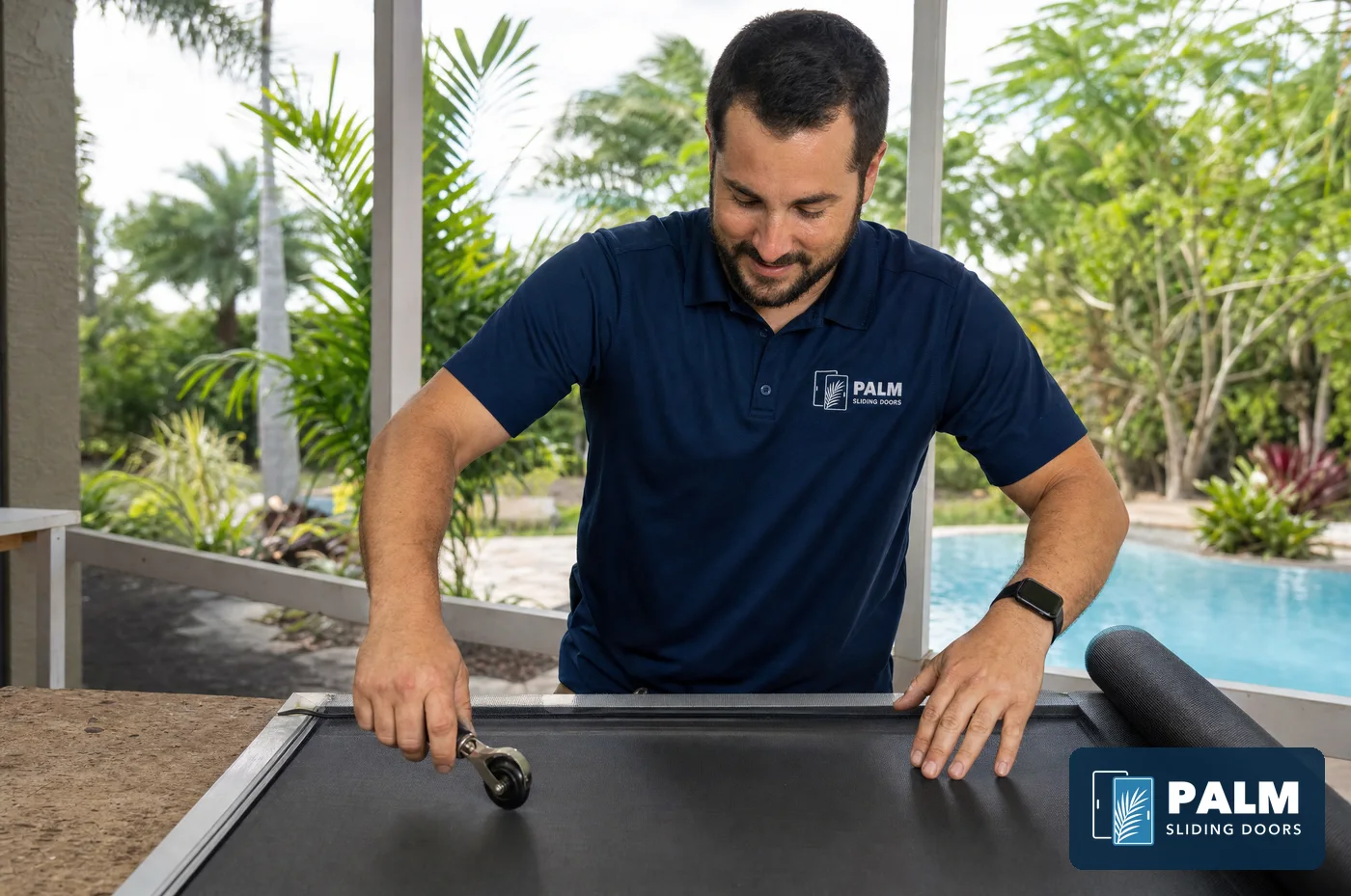
- New mesh is laid over the frame, rolled into the groove with a spline tool, tensioned as it goes so the panel ends up tight and flat, and trimmed.
- The rollers and latch are checked while the door is off.
Choose the mesh with some thought. Standard fiberglass is fine for most doors. Pet mesh is a heavier vinyl coated polyester that dogs and cats do not tear through, and it is worth it on any door a pet uses daily. Fine no see um mesh keeps the tiny biting midges out on a lanai near the water, at the cost of a little airflow. Aluminum mesh lasts but dents.
If the frame is straight and the rollers are good, a rescreen is a complete repair.
Rollers: when the door drags or jumps the track
Screen door rollers are small and cheap, and the wrong ones are a common reason a “repaired” screen door still misbehaves. There are dozens of patterns: top or bottom mount, spring loaded or fixed, steel or nylon wheels, different housing widths.
What a proper roller job involves:
- The door is removed and the old rollers identified by pattern, not guessed at.
- New rollers are fitted top and bottom as the door requires. Near the coast, stainless housings are worth asking for.
- The door is rehung and the rollers adjusted so it sits level, stays in the top channel, and slides without dragging.
- The screen track is cleaned and, if it is bent, straightened or replaced.
Adjustment matters as much on a screen door as on the glass door. A screen door that is too low drags; too high and it pops out of the bottom track every time someone leans on it.
Latch, handle and small parts
The latch and pull are plastic or zinc, they fail, and they are quick to replace with a matching part. The strike on the jamb sometimes needs moving after a roller job so the latch lines up again. These are usually handled on the same visit as a rescreen or rollers rather than as a separate call.
Sliding screen door replacement: when to stop repairing
A new screen door is the better spend when:
- The frame is kinked or twisted. A bowed rail can be straightened; a bent corner leaves the door out of square so it never sits in both tracks at once.
- The corners are corroded through. Once the corner keys rust, the frame goes loose and no amount of mesh or rollers helps.
- The door is a light builder grade frame that has never worked. Some original screen doors are so thin that they flex out of the track when a breeze catches them. A heavier extruded frame stays put.
- You want a heavier duty door for pets or a wide opening. Heavy duty frames with larger rollers exist for eight foot openings and for doors that take a beating.
- Repairing costs more than it should. If the door needs mesh, rollers, a latch and a straightened frame, ask for both quotes and compare.
A replacement screen door is measured to the opening rather than pulled off a shelf, because the height, the track spacing and the roller type vary by the glass door it belongs to. The quote depends on the size of the opening, the frame weight and the mesh you choose, and it is usually a single visit once the door is made.
Screen doors and impact sliding doors
If you have an impact sliding glass door or are planning one, note that the screen door is a separate light panel on its own track and is not part of the impact rating. It does not need to be, and it should never be relied on for storm protection. Take it off and store it flat before a storm if the lanai is not enclosed; a screen door in a hurricane is a projectile.
Keeping a screen door alive
- Vacuum the screen track whenever you vacuum the glass door track.
- Do not force a door that has jumped its track. Lift it back in.
- Keep the door latched in windy weather so it is not slamming back and forth on its rollers.
- Teach the dog to wait. Failing that, buy pet mesh.
FAQ
Is it worth repairing a sliding screen door?
Usually. If the frame is straight, a rescreen or a roller replacement makes it as good as new for far less than a new door, and both are single visit jobs.
How much does it cost to rescreen a sliding screen door?
The quote depends on the size of the door and the mesh you choose, with pet and no see um mesh costing more than standard fiberglass. Ask for the number before the door comes off the track.
Why does my sliding screen door keep coming off the track?
Worn or badly adjusted rollers in most cases, or a bent bottom rail or track. Rollers are replaced and adjusted; a bent rail is straightened or the door is replaced.
Can a bent sliding screen door frame be fixed?
A gentle bow in a rail can often be straightened. A kinked corner or a twisted frame cannot, and a new door is the better spend.
What is the best mesh for a screen door with dogs?
Pet mesh, a heavy vinyl coated polyester, is the one that holds up to claws. Standard fiberglass tears on the first attempt.
If your screen door drags, sags or has a hole the dog made, book a sliding screen door repair and we will tell you on site whether it is a rescreen, rollers or a new door, and quote whichever it needs before starting. While we are there, we can look at the glass door too; our guide to fixing a sliding glass door that won’t slide explains what we check.
References