
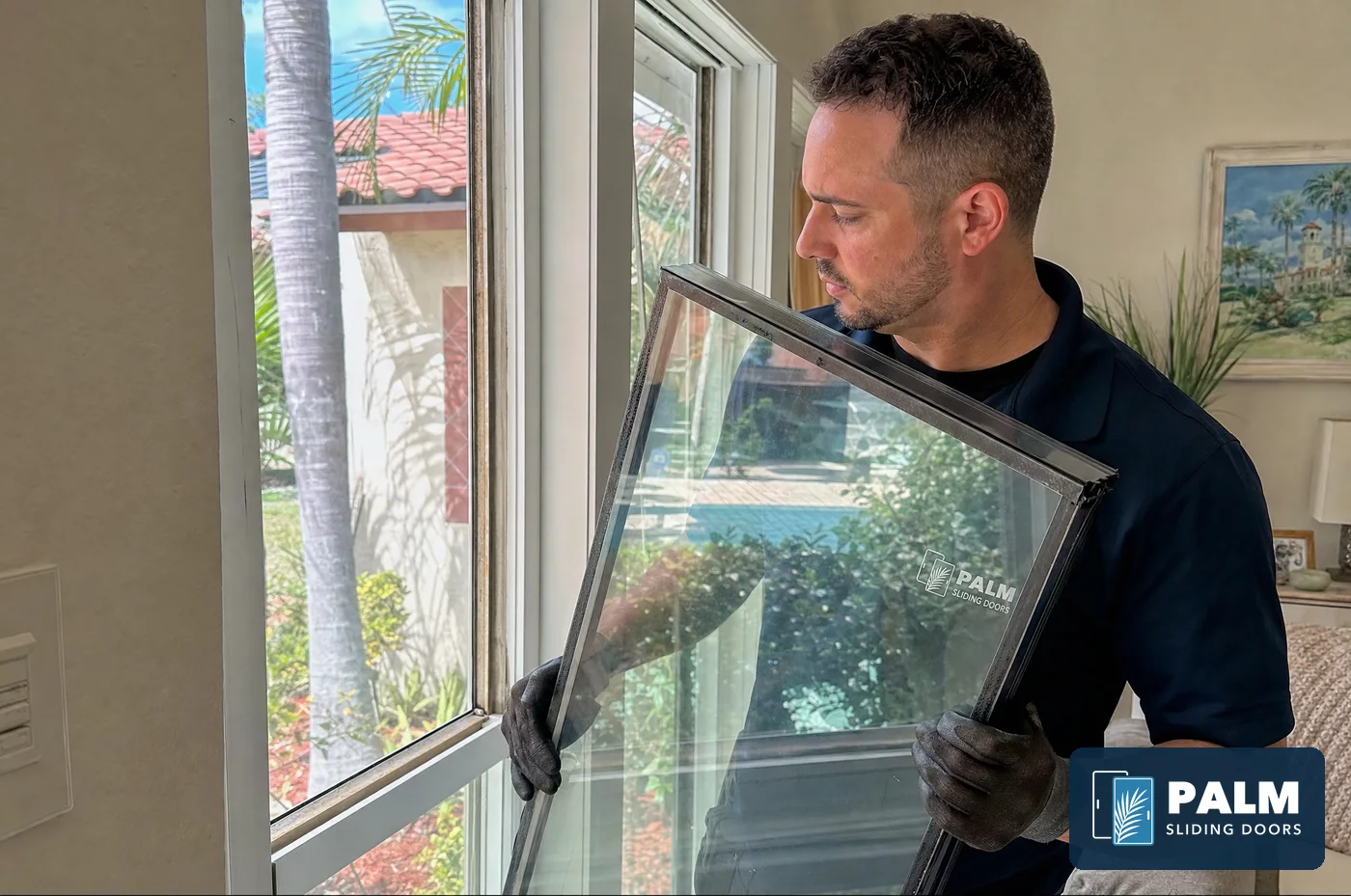
A single hung or double hung window that will not stay open, slams shut the moment you let go, or feels dead when you lift it almost always has a failed balance. The balance is the spring and pulley unit hidden in each side of the frame that carries the weight of the sash, and when it breaks the sash has nothing holding it up. The fix is to replace both balances as a matched pair, check the pivot bars and tilt latches that connect them to the sash, and reset the window so it holds at any height. On a standard vinyl or aluminum window it is a same-day repair with parts from the truck, and it costs far less than new glass or a new window.
What is the spring balance in a single hung window?
Open the window a few inches and look into the narrow channel on either side of the sash. The long plastic or metal strip running down the jamb is the balance. Inside it is a coiled spring attached to a cord that runs over a small set of pulleys, which is why it is called a block and tackle balance. The cord ends in a plastic shoe at the bottom of the channel, and the bottom corner of the sash locks into that shoe through a metal tab called a pivot bar.
When you lift the sash the spring extends. When you let go, it pulls back against the weight of the glass with just enough force to hold the sash where you left it. Two balances share the load, one per side; a double hung window has two moving sashes and four. Some newer vinyl windows use a constant force balance instead, a flat coil of spring steel in a drum at the top of the jamb, and it fails the same ways.
Why do window balances fail in Florida homes?
A balance is a spring under constant load, so it has a working life anywhere. Tampa Bay shortens it.
Heat. A west-facing window in Brandon or Wesley Chapel sits in direct sun all afternoon. Vinyl housings distort, plastic shoes and pulleys go brittle, and aluminum frames in older block homes conduct that heat straight into the channel.
Humidity and salt air. The spring is steel, and steel rusts. Damp air in the channel and salt from the bay pit the coil and seize the pulleys. A balance near the water in South Tampa can be rusted solid while the window looks fine.
Age. The 1990s and 2000s subdivision boom across Riverview, Brandon, Valrico and Wesley Chapel used builder-grade vinyl and aluminum single hung windows, and those balances are now past their design life. When one fails the rest are close behind, so a technician will usually check every window on the visit.
Hurricane season. Windows that stay shut and locked for months, then get thrown open on the first cool morning of November, put a sudden shock through a spring that has been sitting under tension. The cord snaps or the shoe lets go, and the sash drops.
How do I know it is the balance and not something else?
Several faults look alike from across the room. Here is how to tell them apart.
Failed balance. The sash goes up easily but will not stay, or it slams shut when released. One side may hang lower than the other, and you may find a loose cord in the channel. A window that suddenly feels much heavier, or rises on one side and jams, has a balance that lost its tension or a pivot bar that popped out of its shoe.
Stuck sash. The sash will not move in either direction, but once freed it stays wherever you leave it. That is friction, not a dead spring, and dirt or dried paint in the channel is the usual cause.
Swollen or distorted frame. A vinyl frame on a sunny wall can bow inward enough to pinch the sash. The window moves stiffly along its whole travel and the gap around the sash is uneven.
Paint seal. On an older aluminum or wood window, a sash painted shut will not move at all. Score the paint line with a blade before you blame the hardware.
Broken lock or tilt latch. A lock that turns but does nothing is a separate hardware fault. A broken tilt latch lets the top corner of the sash flop out of the frame, which is often mistaken for a balance problem.
A quick home test: open the window halfway and let go. If it holds, the balances are working. If it drops or drifts, they are not.
What does a balance repair visit look like?
The technician lifts the sash, tilts it in, frees it from the pivot bar shoes and takes it out of the frame. The old balances come out of the channel, and this is where the measurement happens.
Balances are not generic. They are matched to the sash by its weight and by the length of the channel. A spring that is too weak lets the window drop; one that is too strong makes it creep up on its own. The technician weighs the sash on a scale, measures the old balance end to end, reads the stamp on the housing if it is still legible, and selects a replacement rated for that load.
Both balances on a sash are replaced as a pair, even if only one has failed. The second has carried the same load for the same years, and a new spring working against a tired one lifts the sash unevenly and finishes off the old one.
With the sash out, the rest of the hardware gets a look: the pivot bars on the bottom corners, the tilt latches on the top corners, the shoes in the channel, and the weatherstripping along the sides and meeting rail. Pivot bars bend and rust, tilt latches crack, shoes wear flat, weatherstripping flattens and lets hot air in. All are small parts replaced on the spot. The sash goes back in and the window is run through its full travel until it holds at every height and the lock catches without lifting.
When is new glass or a new window the better fix?
A balance replacement is right when the frame is sound and the glass is clear. Three situations change the answer.
Fogged or broken glass. If the insulated unit has lost its seal and gone cloudy, or a pane is cracked, a new balance will not fix what you look through. The glass is replaced, and the balances are done at the same time because new glass may weigh more than the old.
A failed frame. A vinyl frame that has bowed, cracked at the corner welds or pulled away from the stucco return, or an aluminum frame corroded through at the sill, cannot hold a repaired sash square. At that point a new window is the honest recommendation.
Hurricane protection. If impact windows are already planned for the house, balances for a window that will be gone next year make little sense.
What drives the cost of a balance repair is the number of windows, whether the sashes are standard or oversized, whether pivot bars, tilt latches and weatherstripping also need replacing, and whether the balance is a common size on the truck or a discontinued type that has to be matched. A flat quote comes after the inspection and before any sash comes out.
Why is window balance repair a same-day job?
Because almost everything about it is predictable. Balances come in a known range of lengths and spring weights, the technician carries the common sizes and all the small hardware, and the sash comes out and goes back in from inside the house. The only variable is a rare or discontinued unit that needs a return visit once the match arrives.
Palm Sliding Doors is locally owned and insured, serving Tampa Bay with same-day window repair, a free on-site inspection, a flat quote before work starts and a 1-year parts and labor warranty. We cover the newer subdivisions around Riverview and Brandon as well as the older block homes of South Tampa, and the same truck that repairs sliding doors on the lanai carries the window hardware. If a window slams, drifts or will not budge, contact us and we will tell you whether it is a balance, a sash or something else.
Frequently asked questions
Why does my single hung window slam shut when I open it?
The spring balance on one or both sides has broken or lost its tension, so nothing is holding the weight of the sash. Leave the window closed and locked until it is repaired, and do not prop it open with a stick; a sash that drops on a hand is a real injury.
Can I replace a window balance myself?
It can be done, but the sash has to come out of the frame and the replacement has to match the sash weight and channel length exactly, or the window will drop or creep. Many homeowners who try it end up with a cracked pane from a sash that got away.
Do I have to replace both balances if only one is broken?
Yes. The two balances on a sash share the load and are the same age. Pairing a new spring with a worn one lifts the window unevenly, stresses the pivot bars, and fails the old balance within months.
Is it worth repairing a window in a 1990s house?
Usually, yes. A vinyl or aluminum single hung window with sound glass and a square frame has plenty of life left once the balances and hardware are new, and the repair is a fraction of what a new window costs. Replace instead when the glass has fogged or the frame has failed.
Can you repair windows on a lanai or in a concrete block home?
Yes. Lanai windows and windows set into block are the same units as the rest of the house, just harder on hardware because of the heat and pool splash. The balances come out through the sash channel from inside, so the block is not a problem.
References