
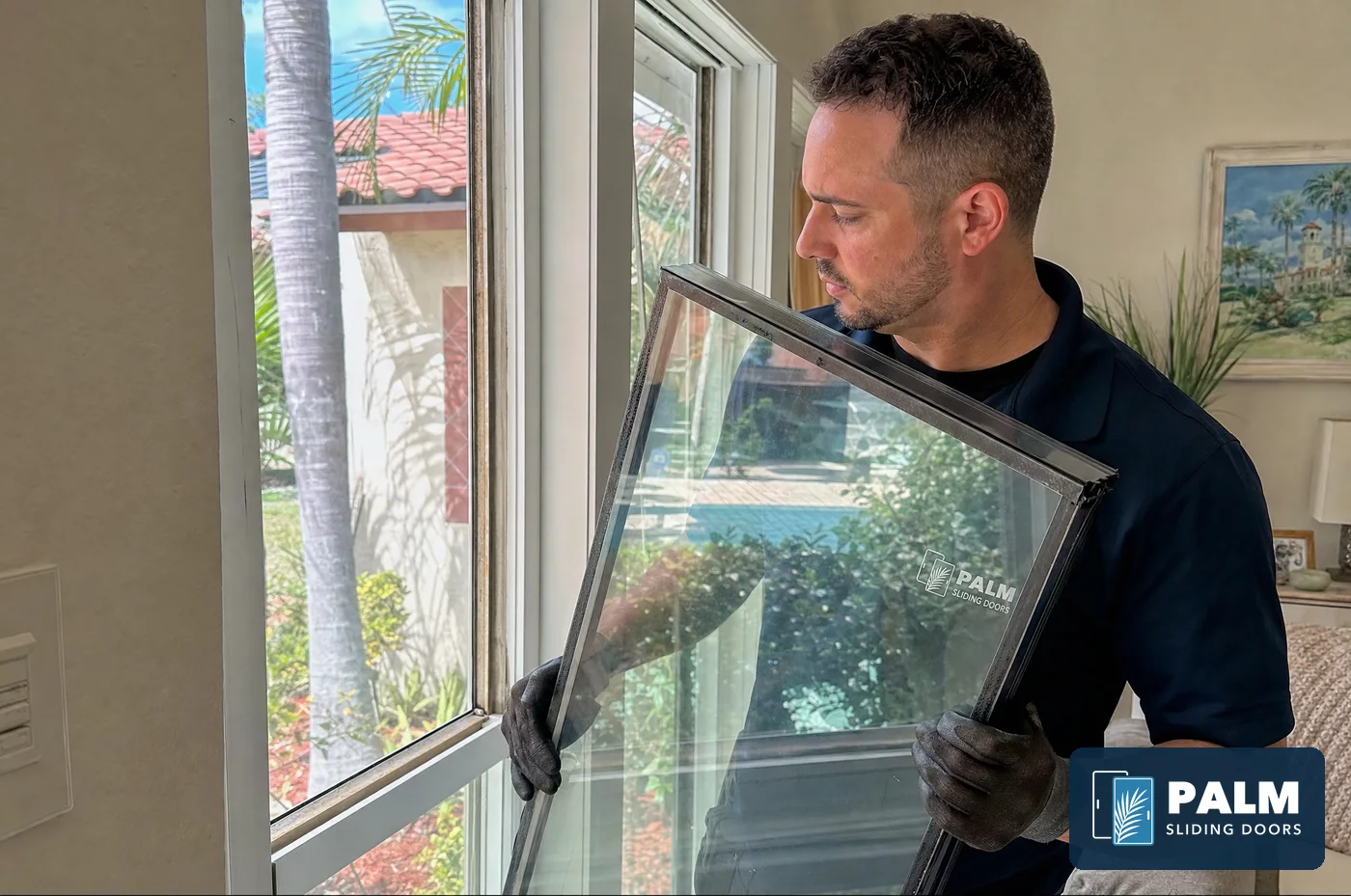
A foggy or cloudy window that will not wipe clean means the seal around the insulated glass unit has failed and moisture is trapped between the panes. Foggy window repair, in practice, means replacing that sealed glass unit; the frame stays, and the new unit goes into the same sash or panel.
This guide explains why seals fail so often in Florida, how to tell a failed seal from ordinary condensation, why the various “defogging” fixes do not last, and what a fogged glass replacement involves on a window or a sliding glass door in Tampa Bay.
What is actually inside a double pane window
A modern window or sliding door lite is not one sheet of glass. It is an insulated glass unit: two panes separated by a spacer around the edge, with the space between them sealed and filled with dry air or argon. Many units also carry a low E coating on one inner surface. That sealed, dry gap is what makes the glass insulate and keeps a west facing room in Brandon or Tampa from turning into a greenhouse every afternoon.
The seal is the weak point. It is a bead of sealant around the spacer, and the spacer holds a desiccant that absorbs whatever moisture gets through. When the sealant cracks or the desiccant is saturated, humid air is drawn into the gap every time the glass cools at night. It condenses on the inner surfaces, and there is no way to wipe it off.
Why seals fail early in Florida
Insulated units fail everywhere eventually, but they fail faster here, for reasons that are easy to spot once you know them.
Heat cycling. The glass expands in the afternoon sun and contracts at night. Every cycle flexes the sealant. A south or west facing slider in St. Petersburg sees more of that than the same door in a cooler climate.
Humidity. When the seal does open, our air carries far more moisture than most places, so the desiccant saturates quickly and the fogging shows up within months rather than years.
Water in the frame. If the weep holes in a window sill or a sliding door track are blocked, water sits against the bottom edge of the unit, where the sealant is, and works into it.
Age and sun. The sealant itself degrades under UV. Units from the 1990s and early 2000s are reaching the end of their life across Tampa Bay, which is why so many homeowners in Clearwater and Carrollwood are seeing fog in more than one window at once.
Failed seal or ordinary condensation
Before you call anyone, work out where the moisture is. It matters because two of the three cases are not a glass problem at all.
- Moisture on the inside surface of the glass, in the room. Wipe it. If it comes off, it is condensation from indoor humidity meeting a cool surface. Common on a cold morning after the air conditioning has run all night. Not a seal failure.
- Moisture on the outside surface. Also wipes off. It is dew on a cold pane on a humid morning and it is actually a sign the glass is insulating well.
- Moisture, haze, streaks or a white mineral film that will not wipe off from either side. That is between the panes. The seal has failed. Sometimes it comes and goes with the weather at first, then it stays.
A seal that has been failed for a while often leaves a permanent white or rainbow film even when the moisture has dried out. That is mineral deposits and the etched remains of the low E coating, and it is why a long fogged unit never clears up on its own.
Why defogging does not last
There are services and kits that drill a small hole in the unit, flush the cavity, dry it out and fit a tiny vent. The glass looks better for a while. But the seal is still failed, the desiccant is still saturated, the gas fill is gone, and any low E coating that has been attacked by moisture is not coming back. The unit no longer insulates the way it did and it fogs again. For a window you plan to live with, it is money spent twice.
Replacing the sealed unit is the repair that fixes the cause, and on most windows and sliding doors it is straightforward because the glass was designed to come out of the frame.
What a fogged glass replacement involves
Whether it is a window sash or a sliding glass door panel, the job follows the same shape.
- Measure and identify. The technician measures the glass and the overall unit thickness, notes whether the existing glass is tempered (required in doors and near floors under Florida building code), tinted or low E, and checks that the sash or panel frame is sound. The quote depends on the unit size, thickness and coatings, and you get it before anything is ordered.
- Fabricate. A new insulated unit is built to those measurements at a glass shop. Tempered lites are heat treated before assembly, so the measurement has to be right. Allow a few days.
- Swap. The sash or panel is removed, the old unit is taken out of its channel, the channel is cleaned, and the new unit goes in on fresh setting blocks and gaskets, with the weep path clear.
- Rehang and check. The sash or panel goes back, is adjusted so it closes and locks, and the seal to the frame is checked. On a sliding door old enough to fog, this is also the time to look at the rollers.
On a sliding door, this is exactly the glass replacement job. On a window, it is the core of what window repair usually means in Florida.
When to replace the window or door instead
Replacing the unit is right when one or two lites have fogged in an otherwise sound frame. It stops being the best spend when:
- Most of the windows on one side of the house are fogging at once. The rest are close behind, and a whole house glass swap is not far from the price of new windows with a new frame and a warranty.
- The frame or sash is rotted, corroded or racked so the new unit will not seal.
- You want impact protection. A fogged window is the natural moment to look at impact windows, which bring laminated glass, a stronger frame and, for many Tampa Bay homeowners, a wind mitigation credit. Many carriers offer credits for rated opening protection; confirm the details with your carrier.
Keeping the next seals alive
You cannot make a seal immortal, but you can slow the failure.
- Keep the weep holes in every sill and track clear so water drains instead of sitting on the edge of the glass.
- If a window or slider bakes all afternoon, a tint or a low E unit at replacement time reduces the heat cycling that kills the sealant.
- Fix a fogged unit when you notice it. Long term moisture etches the coating and eventually the glass, and a unit that could have been a quick swap ends up needing the frame looked at too.
FAQ
Can foggy windows be repaired without replacing the glass?
Not in a lasting way. Defogging drills and dries the cavity, but the seal is still failed and the unit fogs again. Replacing the sealed glass unit is the real repair, and the frame stays.
Why is my window foggy on the inside when I cannot wipe it?
Because the moisture is between the two panes, not on a surface you can reach. That is a failed seal in the insulated unit.
Does a foggy window mean I need a whole new window?
Usually not. If the frame is sound, only the glass unit is replaced. New windows make sense when several units are failing at once or when you want to move to impact glass.
How long does fogged glass replacement take?
The measurement visit is short. The new unit is built off site, usually within a few days, and the swap is done on a single return visit.
Is fogged glass a sign of a bigger problem?
Sometimes. Blocked weep holes or a frame that holds water can kill a seal early, so a good technician checks drainage at the same time as the glass.
If your glass has clouded over, book a window repair visit and we will confirm the seal has failed, measure the unit, and quote a replacement on site. For fogged sliding door panels, our guide to replacing the glass in a sliding door covers the panel side of the job.
References